Music promo: how to build a system that compounds with every release
Learn what music promo actually is, which channels compound over time, and how to build a release system that owns fan data across every launch.

Music promo is the decision every artist faces the moment a track is finished - not whether to promote, but how to do it in a way that actually builds something beyond a single release cycle.
Over 120,000 tracks land on streaming platforms every day (Cyber PR Music, 2026). The challenge is not access to distribution, but is that most promotional efforts reset completely at the end of each campaign, leaving no data, no owned audience, and no infrastructure to make the next launch faster or cheaper.
The artists and teams seeing consistent returns are not necessarily spending more on promotion. They are spending in a coordinated sequence - one where each channel feeds the next, and every fan interaction adds to a body of intelligence that carries forward.
Music promo works when channels reinforce each other
The most common structural mistake in music promo is running channels in isolation. An artist runs Meta ads for a week, submits to playlists, sends one newsletter, and considers the campaign done.
Each piece may work individually, but none of them talk to each other - and the compounding effect drops significantly as a result.
According to Chartlex’s analysis of over 2,400 artist promotion campaigns (2026), paid promotion lifts listener-to-follower conversion to 8.3 percent, against a 2.1 percent organic baseline.
That gap exists not because paid promotion is inherently more powerful, but because structured campaigns give the algorithm clear intent signals to optimize against.
The four layers that consistently produce returns when coordinated:
Paid social (Meta, TikTok): discovery reach, targeting by genre affinity and geography, lookalike audiences built from existing fan data
Playlist pitching (Groover, SubmitHub, Spotify Editorial): algorithmic fuel, with a 4.5 percent save rate needed to trigger sustained Spotify carry (Chartlex, 2026)
Press and blog coverage: credibility signal for curators, booking agents, and label scouts - but fan contact data stays with the outlet, not the artist
Owned channels (email, SMS, DM automation): the only layer where reach is algorithm-independent and data compounds with every release
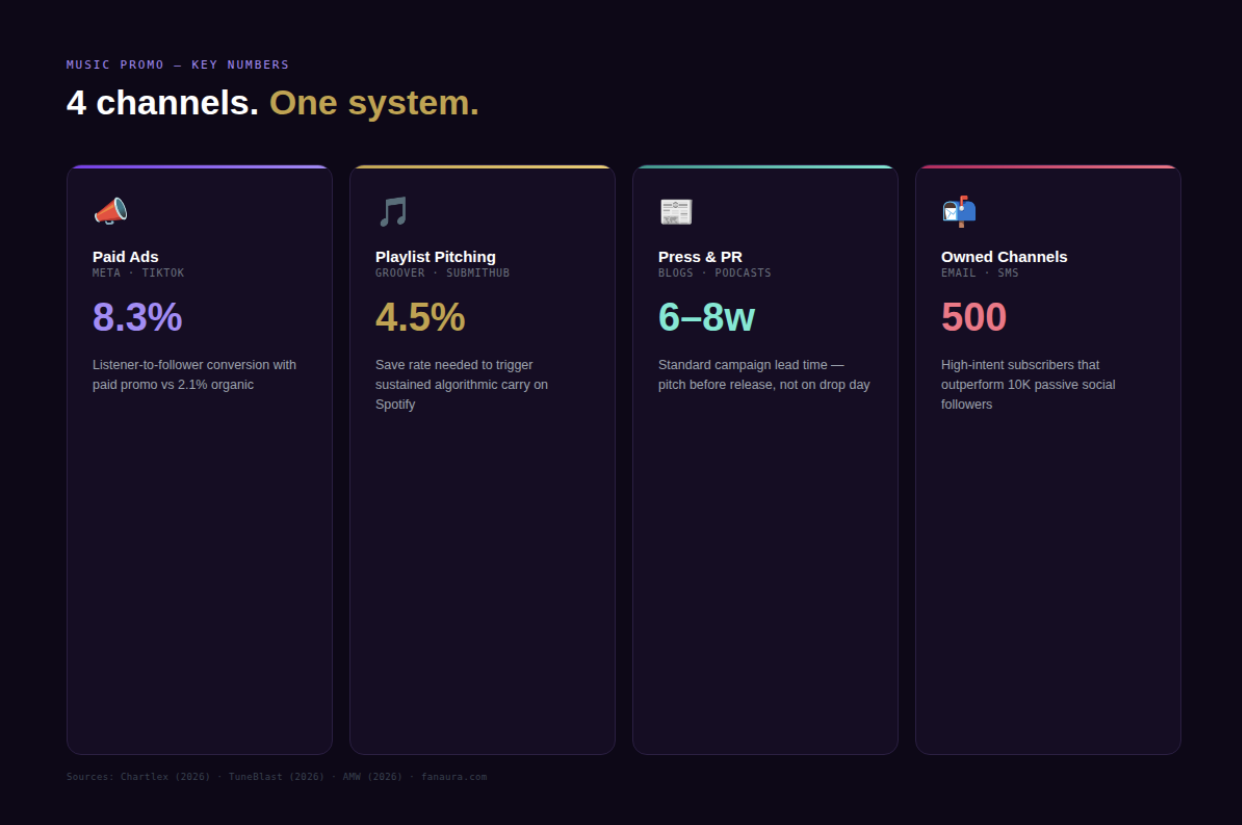
Understanding how those layers interact before spending a dollar is what separates a launch that builds from one that resets. The best way to advertise music is not a single channel - it is the sequence connecting them.
The pre-release window: where most music promo budgets are wasted
Most artists treat promotion as something activated the day a track drops. That timing makes every dollar harder to earn back.
Without pre-release momentum, ad platforms have no behavioral data to optimize against.
Release day arrives with no accumulated intent signals, no segmented audiences, and no pre-save data feeding the streaming algorithm.
The window closes before organic discovery has time to catch up.
The pre-release phase - typically four to eight weeks before launch - is where the structural advantage is built:
Six to eight weeks out: research and target blog and editorial lists; begin building the audience asset that will receive the release
Four to six weeks out: pitch to editorial playlist curators via Spotify for Artists; approach top-tier blogs with exclusive stream access
Two to three weeks out: activate pre-save campaigns tied to an opt-in mechanism; this is the moment to capture fan contact data, not simply pre-save numbers
Launch day: pre-save data drives algorithmic placement; owned list receives direct outreach; press coverage amplifies the signal
According to Spotify’s own reported data (2026), nearly 70 percent of fans who pre-save an album stream it in the first week. The pre-release window is not a promotional tactic - it is the infrastructure that makes the launch itself perform.
Fan data: the asset most music promo leaves behind
Running a music promo campaign without capturing fan data is the most common and most expensive gap in the process.
When a fan discovers an artist through an editorial playlist, a blog feature, or a paid ad, that interaction lives on the platform where it happened.
The fan’s contact information, location, and engagement behavior never enter the artist’s system unless there is infrastructure specifically designed to capture it.
According to TuneBlast (2026), a direct subscriber list of 500 high-intent fans consistently outperforms a social following of 10,000 passive ones.
The difference is intent. A fan who opted in with their email or phone number is demonstrating real interest - and that contact is an asset the artist fully controls, regardless of what any platform’s algorithm decides next cycle.
That is the structural logic behind Fanaura’s approach to release infrastructure: every fan action - a pre-save, a merch purchase, a tour RSVP - feeds data back into the system.
By launch day, the team knows who those fans are, where they live, and what they are most likely to respond to next.
What press and music PR companies actually contribute
Press coverage is one of the few promotional signals that changes how curators, booking agents, and label scouts perceive an artist.
A placement in a recognized outlet carries credibility that paid advertising cannot replicate.
The structural gap is not in what music PR companies deliver - it is in what they are not designed to do.
A campaign that generates strong press coverage surfaces an artist to new listeners. But those listeners’ contact information, geographic data, and engagement behavior stay on the outlet’s side of the equation.
The campaign that extracts maximum value from a press investment is one where the artist already has a capture mechanism live before the coverage drops.
A fan who reads a blog feature and clicks through to a pre-save opt-in becomes a permanent part of the artist’s direct communication infrastructure.
The same fan clicking to Spotify becomes a monthly listener metric with no path back to the artist.
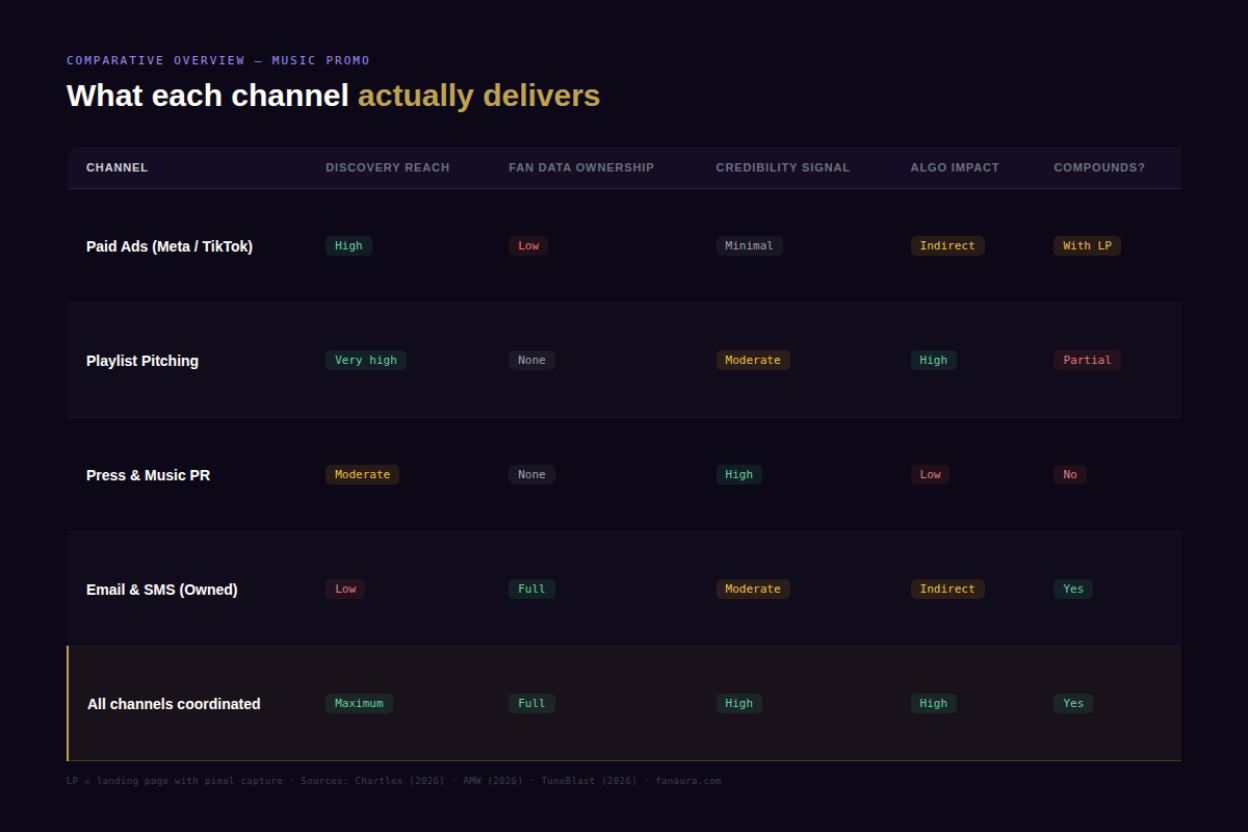
How to run music promo that compounds with every release
The difference between a music promo strategy that compounds and one that resets comes down to a single question: does each campaign teach the system something the previous one could not?
Fan profiles that grow richer, lookalike audiences that tighten, and retargeting pools that expand - these are the assets that narrow the gap between a campaign launch and real streaming impact over successive releases.
Fanaura connects music launches, merch drops, and tour campaigns into a single system where every fan action sharpens the targeting and messaging for the next launch automatically. In practice, that means:
Capture fan contact data at the pre-release stage, before streaming platforms absorb it
Build owned lists (email, SMS) that operate independently of algorithm changes
Route ad traffic through landing pages that fire pixel conversion events for future retargeting
Connect press campaigns to opt-in mechanisms so coverage generates owned contacts, not just awareness
Treat each release as a data-gathering cycle that makes the next one cheaper to launch
Take the next step in your music career
Build your career with a marketing team behind you.
Create your account and start planning your next release with Aura Chat.